


Once More unto the Breach: A Preview of Whale Watching Season in Los Cabos
The arrival of Los Cabos‘ most significant seasonal visitors isn’t trumpeted by airport schedule boards or cruise ship bulletins, but after the first few sightings, the news spreads fast: The whales are back.
Unlike our other seasonal guests, the whales aren’t here on vacation. But after the long migration from the Bering Sea (the roughly 10,000 miles traveled by humpback whales is the longest migration made by any mammal), they’ve certainly earned a few leisurely months in the warm waters off Baja California Sur, breeding and birthing calves in the many coves, inlets, and bays that dot the southern Baja coastline. Although the long-haul leviathans sometimes arrive as early as November, and leave as late as April, the heart of whale watching season in Los Cabos is from the beginning of January through the end of March. Each year during this period, as many as 10,000 cetaceans arrive in Baja California Sur, from grays and humpbacks to blues, fins, sperms, and even orcas.
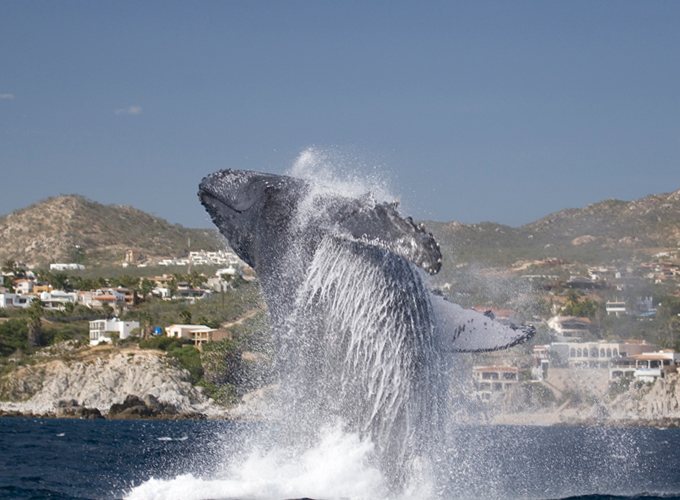
A humpback breaches just off the coast of Cabo San Lucas. Image: Cabo Expeditions
Humpbacks are the most commonly sighted whales in the waters off Los Cabos, although large numbers of grays are often seen after they’ve left their traditional breeding grounds in Magdalena Bay, located on the Pacific Coast about 170 miles north of Cabo San Lucas, and are doing a bit of sightseeing before the long journey to their summer feeding grounds. Humpbacks continue into the Sea of Cortés to breed, and they are the stars of Los Cabos whale watching tours, due to their large numbers and spectacular breaching.
Humpbacks leap almost completely out of the water when breaching, displacing huge amounts of water upon splashdown in a sort of ersatz cannonball. Canny boat captains track the course of humpbacks by the spray they send up from their blowholes, and can often anticipate where they will breach next, allowing passengers excellent photo opportunities. Other typical yet photogenic whale surfacing behaviors include spy-hopping—raising an enormous head out of the water for a quick look around—and lob-tailing—slapping the water with massive tail flukes.
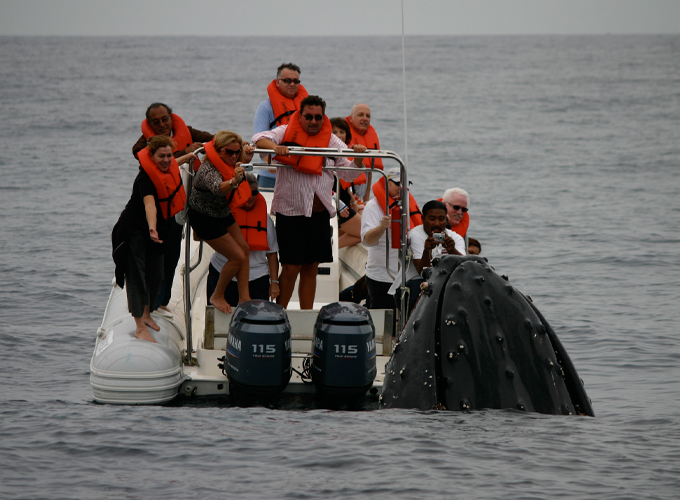
A spy-hopping humpback greets his fans. Image: Cabo Expeditions
During the height of whale watching season, the transiting marine mammals are often visible from any number of shoreside vantage points, including local beaches, luxury hotels, and seaside golf links. But for up-close-and-personal looks at these leviathans of the deep, visitors will want to sign up with one of the many local activities companies that offer seasonal whale watching tours.
Cabo Expeditions (624-143-2700), the area’s premier adventure company, offers excellent humpback sighting excursions in Cabo San Lucas Bay aboard high-speed Zodiac inflatables, as well as lengthier trips to Loreto and San Ignacio lagoon to see blue and gray whales, respectively. For a more leisurely whale watching experience, Cabo Sails (624-355-6386) boasts several excellent charter sailboats, each of which is helmed by an experienced captain, and amply provisioned with first-class food and beverages. Comfort lovers may also want to consider whale watching catamaran cruises aboard EcoCat (624-157-4685) or Caborey (624-105-1976).