Helping Baja's Sea Turtles - Los Cabos, Baja California Sur, Mexico
Seri Leatherback Release Ceremony
Renewing Spiritual and Ecological Traditions
The Baja California peninsula’s deserts, mountains, seas and arroyos possess a natural mystique unlike any other place on Earth. Time spent on this vast, rugged stretch of land, which cuts through the Sea of Cortez and the Pacific Ocean, often produces experiences described as spiritual, or even life changing.
In early February 2005, a few of us were lucky enough to share a cultural experience with a small group of Seri Indians that blended sea turtle conservation and the preservation of rites sacred to this tribe.
We had just left the seventh Annual Grupo Tortuguero meeting in Loreto, Baja California Sur, Mexico, the region’s premiere grassroots conservation meeting.
Over 300 individuals representing 30 Mexican communities, plus academic institutions, agencies and nonprofit organizations in Mexico and the U.S., came together to discuss work focused on fulfilling three objectives toward sea turtle conservation: network building, expanding knowledge and communicating their messages.
At the Grupo Tortuguero meeting, the Seri Indians received an award for their work conserving sea turtle populations. Five of the world’s seven species of sea turtle inhabit the waters surrounding the Baja California peninsula.
Of these, four are considered ecologically extinct, suffering the affects of longlines, nets and illegal poaching. Put plainly, unless we make far-reaching moves towards conservation, these species will not endure.
The Seri survive as one of the few indigenous populations in Mexico never fully conquered. They live on native lands in northwestern Sonora, and retain their Comcáac language and much of their traditional culture.The Seri regard the leatherback turtle as a sacred embodiment of their ancestors, to be revered and protected.
Years ago, on the rare occasion a leatherback was captured, the Seri would hold a four-day ceremony to provide protection for the turtle before it was released, unharmed.
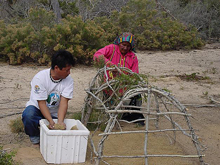
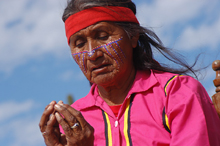
As part of the ceremony, the Seri constructed a special shelter to shade the turtle, blanketed it with elephant tree branches and painted powerful motifs on the turtle’s carapace and flippers.
The community sang sacred leatherback songs, and everyone participated in games and dancing. The Seri maintain strong emotional, spiritual and cultural ties to the leatherback, and believe they communicate with the turtles through their songs.
Unfortunately, it has been over 20 years since the Seri have performed these ceremonies, as no leatherbacks have been encountered in the northern tip of the Sea of Cortez. Only 2,300 adult female Pacific leatherbacks are thought to remain, making it the world’s most endangered marine turtle.
Still, Seri elders envision once again singing to the leatherback and praying for its well-being. They fear that, without a concerted effort, the leatherback and ceremonial traditions could be lost.
With Loreto hours behind, we rushed down a dirt road somewhere north of Todos Santos hoping to keep the Seri tradition alive.
During the sea turtle conservation conference in Loreto, biologists from ASUPMATOMA had informed us that a leatherback nest at their incubator station would soon be hatching, roughly two months after is was deposited on a nearby beach – here was our chance!
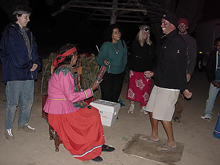
We pulled in to Agua Blanca late at night, just as the first leatherback hatchling broke the sand’s surface. Cleotilde, a Seri elder traveling with us, opened the ceremony with a song and began to cry.
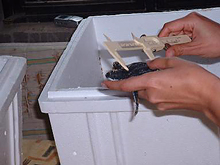
The ceremony was performed with a few modifications. Precautions were taken to safeguard the fragile hatchlings used instead of an adult leatherback, including keeping them in an incubator rather than a house built by the Seri.
In their land, the ritual was always a community event in which the entire village took part With only five Seri members present, members of Pro Peninsula, Grupo Tortuguero, ASUPMATOMA and others became the community.
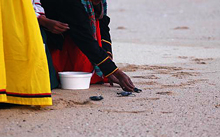
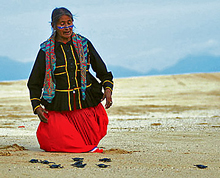
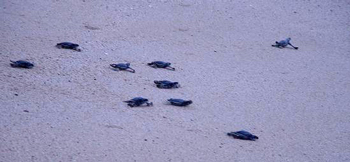
When it came time to release the hatchlings, Cleotilde and some Seri youth led a procession down to the beach, the vibrant colors of their dresses complimenting the beauty of the setting sun, as birds flocked overhead and gray whales breached just yards past the breaking waves. As Cleotilde sang, the turtles struggled to make their way out to sea.
The significance of the event sunk in, and we watched as this tradition was passed down to the younger Seri generation. This event brought us together from worlds apart in the hope to both protect sea turtles throughout the region and renew the spiritual and cultural practices of the Seri Indians.
How can you get involved? Donate, volunteer, sponsor a turtle through ASUPMATOMA, participate in a release program, and please don't drive, take ATVs, or horses on the beach. To learn about Campamento Tortuguero Don Manuel Orantes and ASUPMATOMAs’ hatchling release and sea turtle conservation programs, visit www.grupotortuguero.org
Authors Kama Dean and Chris Pesenti are Co-Founders of Pro Peninsula.
For more information about Pro Peninsula,
ASUPMATOMA, and the Grupo Tortuguero,
and to see photos from this event, visit www.propeninsula.org.